The 1952 Red Man Tobacco Set
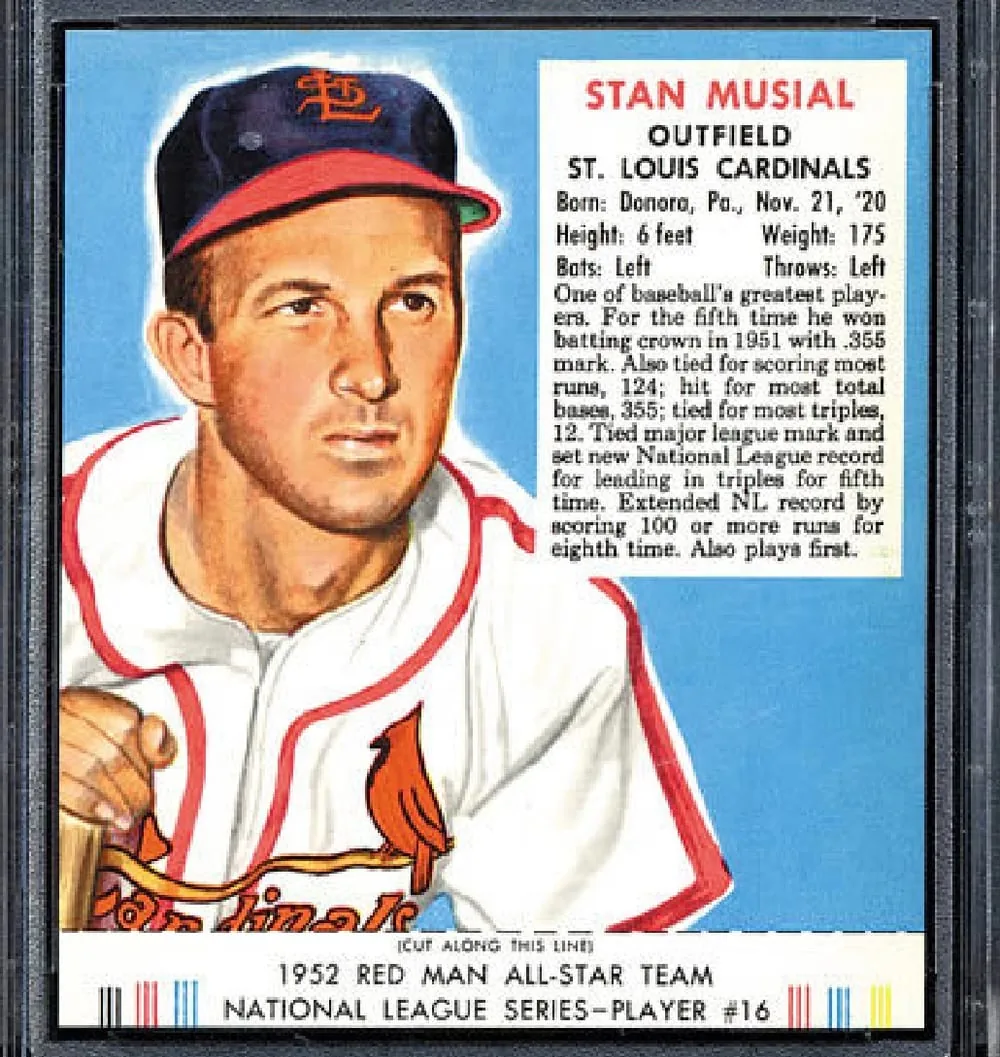
While Topps and Bowman were fighting their famous war over the pennies of gum-chewing kids in 1952, a chewing tobacco company quietly did something nobody had done in about forty years: it put baseball cards back in tobacco products. The last time that happened, the T206 Honus Wagner was new.
The 1952 Red Man set is the result — one of the most beautiful, strangest, and most underrated issues of the entire decade. And it comes with a built-in collecting puzzle that makes it unlike anything Topps or Bowman ever made: the tab.
Disclosure: This article contains eBay affiliate links. If you buy through them, I may earn a small commission at no extra cost to you — it helps keep this site going.
What is the 1952 Red Man set?
Red Man chewing tobacco inserted one big, gorgeous card — 3½” by 4” — with each pouch, sealed in plastic on the outside of the package. The set runs 52 cards: the 25 best players in each league, as personally selected by J.G. Taylor Spink, the legendary editor of The Sporting News, plus the two 1951 World Series managers — Casey Stengel and Leo Durocher. That Spink selection gives the set something no other issue has: it’s a snapshot of who the sport’s most powerful voice considered the best 50 players alive in 1952.
The fronts are full-color painted portraits — genuinely some of the best-looking cards of the fifties. The backs carry the company pitch and my favorite line in all of vintage cardboard: “These Baseball Cards are for Red Man ‘Chewers’ and Their Boys.” An adult product, handed down to the kids. That’s 1952 in one sentence.
Twenty Hall of Famers are in the set: Ted Williams, Stan Musial, Willie Mays (in just his second season), Yogi Berra, Bob Feller, Duke Snider, Warren Spahn, Pee Wee Reese, Ralph Kiner, Minnie Miñoso, Larry Doby, Monte Irvin, George Kell, Nellie Fox, Richie Ashburn, Enos Slaughter, Red Schoendienst, Early Wynn, Robin Roberts — plus Stengel and Durocher. And a key exclusivity note: 1952 is the only Red Man year for both Ted Williams and Bob Feller. They appear once in this four-year run, and this is it.
The tab: the whole game in half an inch of cardboard
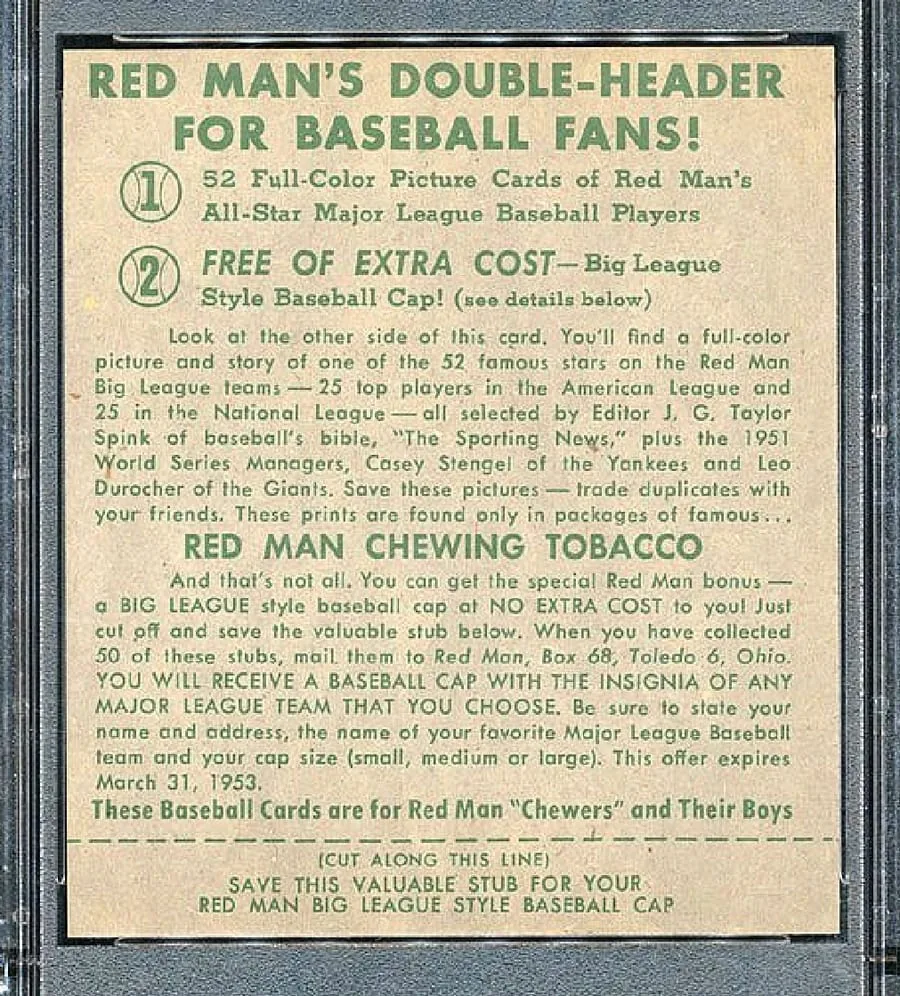
Here’s what makes Red Man collecting its own sport. Every card came with a half-inch perforated tab along the bottom. Collect 50 tabs, mail them in, and Red Man sent you a felt big-league-style baseball cap. Great promotion — and a catastrophe for card survival, because everybody tore the tabs off.
Two things make the tab everything:
First, the card number and date are printed ONLY on the tab. Tear it off and the card literally loses its identity — no number, no year. A tab-less Red Man is an orphan.
Second, the math of the promotion means tabs-intact cards are dramatically scarcer, and they command huge premiums. The 1952s are considered the single hardest year of the four to find with tabs — they were sealed to the outside of the pouch, handled by every hand at the tobacco counter, and then attacked with scissors at home.
How scarce is nice? The numbers
Per PSA’s own registry research on the ‘52 issue: roughly 1,373 cards graded across the entire 52-card set, and only 14 PSA 9s exist for the whole year — including a single Mays and two Musials. PSA 8s make up about 14% of everything graded; the bulk of survivors live at 5, 6, and 7. And the toughest card of the entire four-year Red Man run is believed to be the 1952 Casey Stengel — the finest known copy is a single PSA 8. The Ol’ Perfesser, manager of the mighty Yankees, is the white whale of the whole series.
One more wrinkle for the detail-obsessed: the backs carry one of two expiration dates — March 31 or June 1, 1953 — so every card exists in two back variations. Master-set builders, you know what that means.
What are they worth?
Here’s the good news: this is one of the great attainable oddball sets. Tab-less commons and even mid-tier Hall of Famers are genuinely affordable — a complete lower-grade set without tabs has historically been built for well under four figures. The premiums live in three places: tabs intact (multiples of tab-less prices), the big three (Williams, Mays, Musial), and high grade (where those 14 PSA 9s make the ceiling almost theoretical). A PSA 8 Ted Williams has brought nearly $15,000 at auction.
That structure makes Red Man a rare thing in 1952 collecting: a set where a regular collector can chase Ted Williams and Willie Mays cards without mortgage-level money — and where the discipline of hunting tabs-intact copies gives you a real edge over casual buyers who don’t know the difference.
My take
This set is everything I love in one package: a great story (tobacco cards back from the dead), a built-in insider’s game (the tab), genuine beauty, and a checklist picked by the most important baseball writer of the era. And it’s gettable. Everybody’s fighting over the same Topps and Bowman cards; meanwhile, the best-looking Ted Williams of 1952 is sitting in the Red Man set at a fraction of the attention.
If you’re at a show and you spot a Red Man, do two things: check for the tab first — that half-inch of cardboard is most of the value — and then check the name. If it says Williams, Feller, or Stengel, you’re holding a one-year-only or a condition unicorn. Now you know.
Found one in a collection? These big, plastic-sealed, perforated oddities are exactly what grading was made for. (See “Is It Worth Grading Your Card in 2026?” and “How Card Grading Works in 2026”.)
Explore every 1952 set in the complete 1952 guide →
Related articles
-
1952 Topps Red Backs vs. Black Backs: Which Is Worth More?
A collector’s guide to 1952 Topps red-back and black-back variations — which cards have them,… Read the guide → -
The 1952 Dixie Lids
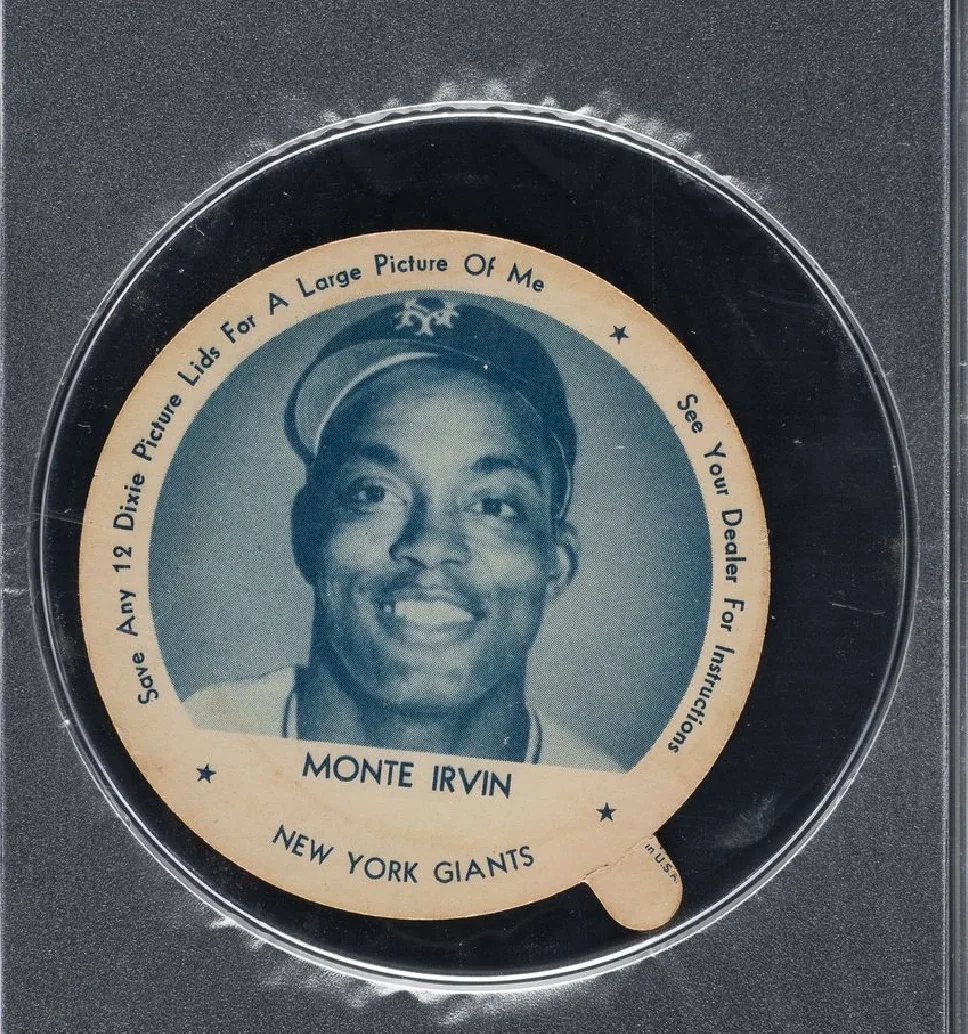
The 1952 Dixie Lids — a 24-lid ice cream set with just 29 graded examples in existence and no… Read the guide → -
The 1952 Berk Ross Set
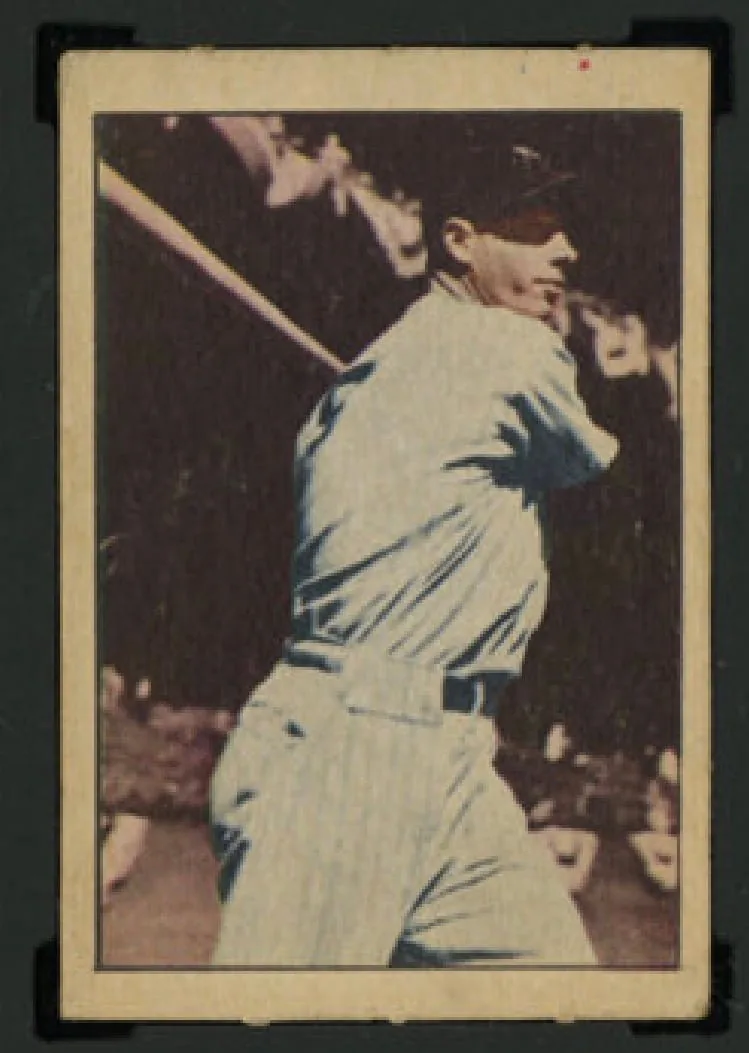
The 1952 Berk Ross set — the unlicensed 'bootleg' that gave the hobby its only 1952 Joe DiMag… Read the guide →