The 1952 Berk Ross Set
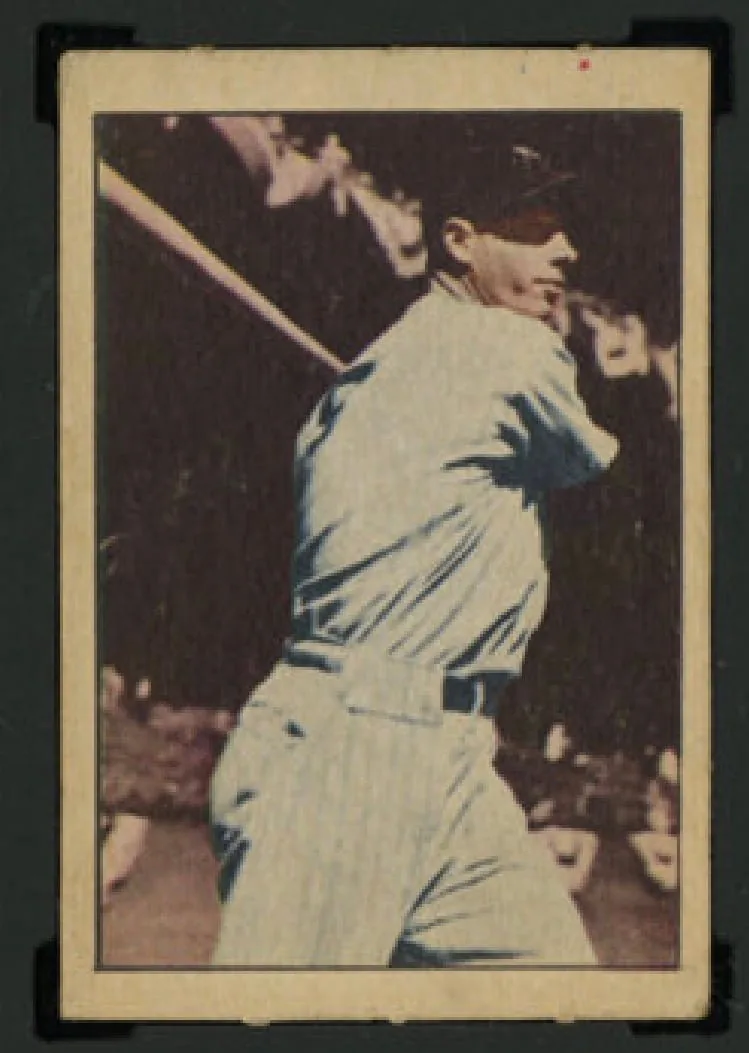
I’ve seen Berk Ross cards in the wild before — and I was too green to know what I was looking at. Moron. I let them go, and it’s one of those ones that stings more the more you learn. So let me save you from making my mistake, because this weird little set is one of the best-kept secrets in vintage collecting.
Disclosure: This article contains eBay affiliate links. If you buy through them, I may earn a small commission at no extra cost to you — it helps keep this site going.
What is Berk Ross?
In 1952, while Topps and Bowman were waging their famous card war, a little New York outfit called the Berk Ross Company quietly put out a 72-card set called the “Hit Parade of Champions.” Small cards, 2” by 3”, sold in one-card packs — and reportedly stuffed into popcorn bags as a promotion. Like the Coke Playing Tips set, distribution was Northeast-only, which is why 46 of the 72 cards are Yankees, Giants, and Dodgers.
Here’s the part that makes the whole thing legendary: Berk Ross almost certainly never licensed any of it. They just printed the cards. It got so blatant that seven New York Giants — including Bobby Thomson and Sal Maglie — actually sued over the use of their images. The Sporting News covered the lawsuit in August 1952. This set is, for all practical purposes, a bootleg.
And that bootleg gave the hobby something neither Topps nor Bowman could.
The only 1952 cards of Joe DiMaggio and Ted Williams
This is the headline, and it’s huge. Because Berk Ross didn’t bother with contracts, they included players the licensed companies couldn’t touch. The result: the ONLY 1952 cards of Ted Williams and Joe DiMaggio in existence.
Think about that. DiMaggio had just retired after the ‘51 World Series — the Yankee Clipper’s career was over, Topps and Bowman had no rights to him, and yet here he is with a 1952 card. Williams was between contracts and appears nowhere else that year. If you want a ‘52 of either legend — and a lot of serious collectors do — this bootleg popcorn set is the only game in town. The DiMaggio and the Mays are a huge part of what makes this set so cool.
The Mantle: rarer than his ‘52 Topps, for a fraction of the price
Here’s the sleeper of sleepers. The Berk Ross Mantle uses essentially the same iconic image as his 1951 Bowman rookie — that classic right-handed batting pose against the sky. (“Borrowed,” let’s say, in keeping with the set’s whole legal philosophy.)
And it is genuinely rarer than his famous ‘52 Topps card. No unqualified Berk Ross Mantle has ever graded higher than a PSA 8 — not one. A PSA 7 sold for $37,777; strong EX/MT copies run around $2,000–$2,500. Compare that to the ‘52 Topps, where a similar-grade copy costs many times more.
That’s the play here: for a fraction of the Topps money, you get a Mantle that’s scarcer than the icon — the same young Mick, the same legendary pose lineage. Something you can say you have that almost nobody else does.
The rest of the checklist — and its quirks
The set packs 23 Hall of Famers into 72 cards: Mays, Jackie Robinson, Stan Musial, Yogi Berra, Campanella, Snider, Feller, Hodges, Reese, Kiner, Mize, Ashburn, and more. The cards are unnumbered (organized alphabetically), with perforation remnants top and bottom from the strips they were cut from — a tell that you’re holding a real one.
And the quirks are pure oddball gold:
- The Blackwell/Fox switcheroo: Ewell Blackwell and Nellie Fox have each other’s photos. A genuine, uncorrected error that ran the whole print run.
- Two Phil Rizzutos: one bunting, one swinging — the Scooter is the set’s double-print star, just like Bobby Thomson was in the Coke Tips set.
- The toughest card is a common: Whitey Lockman. Of the handful ever graded, nothing has topped a PSA 6. In a set full of legends, the condition king is a role player — the Andy Pafko lesson strikes again.
What the pop report actually tells you
I pulled the PSA population report on this set, and one number jumps off the page before any of the others: zero. As in zero PSA 10s. Not on the Mantle, not on the Mays, not on the DiMaggio — not on a single card I looked at. In a set that’s been graded for decades, a perfect Berk Ross simply does not exist.
Here’s the straight-grade census for the key cards (from PSA’s Population Report):
| Card | Team | PSA 8 | PSA 9 | PSA 10 | Total Graded |
|---|---|---|---|---|---|
| Mickey Mantle | Yankees | 23 | 0 | 0 | 342 |
| Joe DiMaggio | Yankees | 22 | 3 | 0 | 295 |
| Willie Mays | Giants | 35 | 7 | 0 | 248 |
| Billy Martin | Yankees | 22 | 3 | 0 | 95 |
| Gil McDougald | Yankees | 10 | 4 | 0 | 79 |
| Bobby Doerr | Red Sox | 17 | 7 | 0 | — |
| Larry Doby | Indians | 16 | 0 | 0 | — |
| Sal Maglie | Giants | 4 | 0 | 0 | 63 |
| Orestes Miñoso | White Sox | 1 | 0 | 0 | 48 |
Start with the Mantle, the card everybody wants. PSA has graded 342 of them — and of those, there are zero straight PSA 9s and zero 10s. The finest you can realistically own is a PSA 8, and there are just 23 of those on the entire planet. Think about what that means: the ceiling on the most famous card in the set is an 8, and even that is a genuinely rare animal.
The Willie Mays tells the same story with a tiny crack of daylight — 248 graded, seven PSA 9s, still no 10. For my money that makes the Mays 9 one of the quietly toughest high-grade cards of any ‘52 issue. Seven copies. That’s it. And the DiMaggio — seventy-plus years of Joe D collectors chasing the only ‘52 card he has — sits at 295 graded with just three PSA 9s. Three.
Now look down the list at the names people call “commons”: Doby, Doerr, McDougald, Miñoso, Maglie, Martin. These aren’t commons — Larry Doby integrated the American League, Miñoso was the first Black Latino star, Bobby Doerr’s in Cooperstown — and PSA has graded fewer than 100 of each. The Miñoso sits at 48 total. When the role players in a set have populations that thin, you understand what you’re really dealing with: a set where almost nothing survived, in any grade.
That’s the whole pitch for 1952 Berk Ross. It’s oddball, it’s overlooked, and the population report proves it’s scarcer than the mainstream sets that cost ten times as much. In this set, a PSA 8 is a trophy, a PSA 9 is a unicorn, and a PSA 10 is a myth.
What are they worth?
The stars carry real money: the Mantle ($2,000–$2,500 in EX/MT, five figures in PSA 7+), the DiMaggio ($400–$750 mid-grade), and the big names — Williams, Mays, Robinson — can hit $5,000–$10,000 in PSA 9. Commons and lesser stars remain genuinely affordable, which makes this one of the few “only card of a legend” sets a normal collector can actually work on.
Condition is rough across the board — poor centering, soft corners, and those perforated edges mean high grades are scarce everywhere. Population counts are tiny compared to Topps and Bowman.
My take: the smart collector’s flex
Everybody has the mainstream stuff. The ‘52 Topps Mantle is the hobby’s most famous card precisely because everyone knows it. But walk into a room of collectors with a Berk Ross Mantle — or the only 1952 DiMaggio in existence — and watch what happens. The people who know, know. And the ones who don’t get to hear one of the best stories in the hobby: the bootleg popcorn set that got sued by the Giants and out-flexed Topps and Bowman by printing the two legends they couldn’t.
I passed on these once because I didn’t know better. Don’t be me. If you see the “Hit Parade of Champions” in a case or a collection — now you know exactly what you’re looking at.
Found one and wondering what to do with it? With an unlicensed oddball like this, grading for authentication matters even more than usual. (See “Is It Worth Grading Your Card in 2026?” and “How Card Grading Works in 2026”.)
Explore every 1952 set in the complete 1952 guide →
Related articles
-
1952 Topps Red Backs vs. Black Backs: Which Is Worth More?
A collector’s guide to 1952 Topps red-back and black-back variations — which cards have them,… Read the guide → -
The 1952 Dixie Lids
The 1952 Dixie Lids — a 24-lid ice cream set with just 29 graded examples in existence and no… Read the guide → -
The 1952 Brooklyn Dodgers Schedule Cards
The 1952 Brooklyn Dodgers Schedule Cards — a four-card Ebbets Field giveaway featuring Jackie… Read the guide →